© 2019 Shine – Superfoods but Super real
All Right Reserved
Se ha utilizado durante siglos.
Pero te dejará como nuevo.
Matcha
Una larga historia requiere mucha energía. Matcha, el poderoso té verde utilizado durante siglos por los monjes japoneses en sus ceremonias de meditación, tiene propiedades que lo convierten en un superalimento único: energizante, revitalizante, antiinflamatorio, antibacteriano, antioxidante, mejora el estado de ánimo y equilibra todo el organismo. Desde siempre. Ahora para ti.
Share on facebook
Share on whatsapp
Share on email
100%
Matcha
Matcha
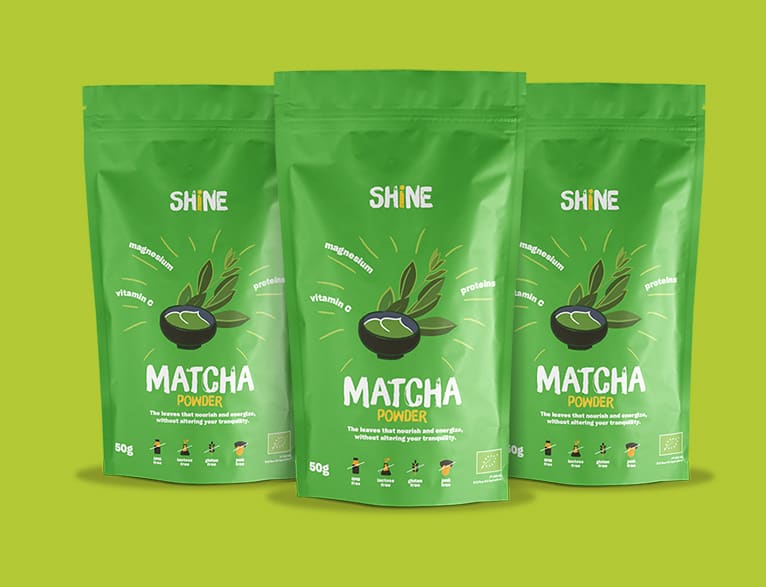
Matcha comes from the camellia sinensis plant, from Japan, and is obtained from unripe green tea leaves. This way, it is a real concentrate of antioxidant nutrients which can at the same time soothe you and give you energy!
Contiene
Antioxidants
Proteins
Vitamin C
Magnesium
Chlorophyll
L-Theanine
Matcha
Contiene
Contributes to a growth in muscle mass.
Contributes to a reduction of tiredness and fatigue.
Contributes to maintain the normal function of the immune system during and after intense physical exercise.
¿Matcha es un tipo diferente de té?
Simple answers to your complex questions.
De hecho el Matcha se obtiene a través de las hojas jóvenes de té verde y por lo tanto tiene mayores concentraciones de nutrientes.
Cuando nos referimos al "té", ya sea verde o negro, siempre nos referimos a la misma planta - Camellia sinesis - pero con diferentes períodos de fermentación y maduración.
Glossario
Uso sugerido
Mezcle media cucharadita de té de Matcha con una gota de agua caliente hasta obtener una consistencia homogénea. Añade agua y mezcla de nuevo.
Declaración nutricional
Por dosis recomendada (8g) y por 100g
Matcha
Nutrition Declaration
Per 1 Tbsp (8g)
Energy (kJ/Kcal)
Fats (g)
– of which saturates (g)
– of which monounsaturates (g)
Carbohydrate (g)
– of which sugars (g)
Fibre (g)
Proteins (g)
Salt (g)
Vitamin C (mg)
Magnesium (mg)
108,24/25,84
0,25
0,06
0,02
2,94
0,07
3,6
1,66
0
13,03
15,83
*1,29%
*0,36%
*0,3%
*1,13%
*0,07%
*3,32%
**16,29%
**4,22%
Per 100g
Energy (kJ/Kcal)
Fats (g)
– of which saturates (g)
– of which monounsaturates (g)
Carbohydrate (g)
– of which sugars (g)
Fibre (g)
Proteins (g)
Salt (g)
Vitamin C (mg)
Magnesium (mg)
1353/323
3,10
0,80
0,30
36,80
0,90
32,40
20,80
0,03
162,90
197,90
*16,15%
*4,43%
*4%
*14,15%
1%
*26,6%
*0,5%
**203,6%
**52,8%
* Reference intake of an average adult (8400kJ/2000Kcal)
** Nutrient reference value